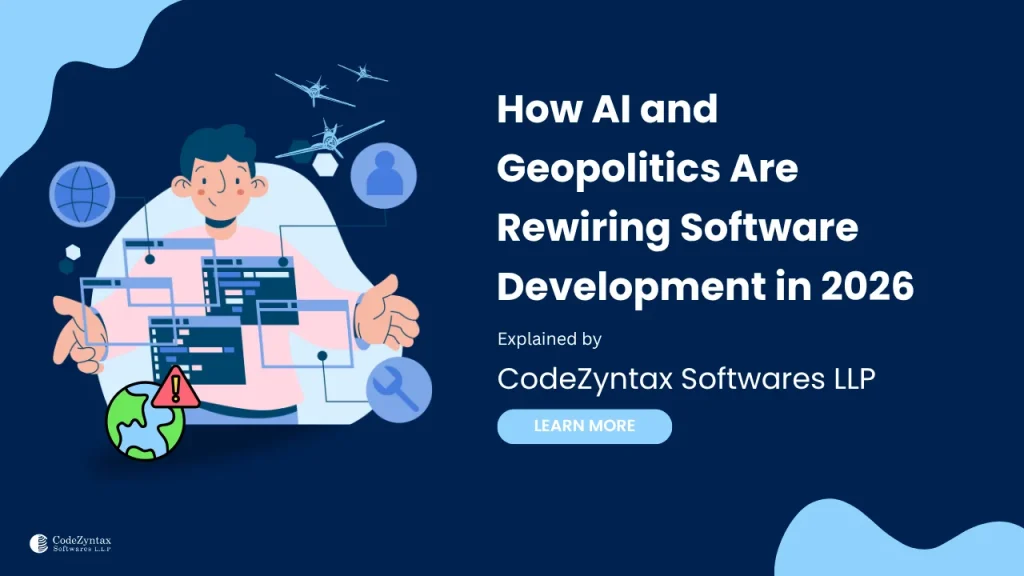
How AI and Geopolitics Are Rewiring Software Development in 2026
As we view developments to 2026, global software development is experiencing a significant transformation driven by three broad influences: the evolution of agentic artificial intelligence; the geopolitical tensions worldwide; and an aggressive move toward security as the foundation of software engineering. Modern software company in Palakkad cannot afford to just be passive observers of these trends; they must treat these trends as essential for survival. In the new software development economy, clients expect that productivity measures enhanced by artificial intelligence (AI) will provide an improved user experience as an inherent, built-in feature, and will not require additional payment. As software vendors utilize AI agents to assist with coding, reviewing and even deploying codes, development teams within this environment will shift from being “coders” to being “orchestrators.” In addition, the emergence of systemic risk due to cybersecurity will compel all software vendors in Palakkad to rethink how they view security and resiliency; security and resiliency must be incorporated into their design process and considered foundational elements of their overall business strategy. This article will discuss how software products will be designed and produced in the year 2026; and, how Palakkad-based software companies can strategically position themselves in the future marketplace. 1. Agentic AI: From Programming Assistant to Autonomous Team Member As of 2026, AI has grown beyond being merely an advanced version of autocomplete in your IDE; Agentic systems can now assist with every aspect of the software development lifecycle (SDLC) from requirements definitions to testing and deployment. For a software development company located in Palakkad, Agentic AI tools have become a first class “team member”. With Agentic AI tools, developers can: Create boilerplate code and create base templates for their infrastructures. Provide recommendations for architectural designs based on their required level of non-functional requirements. Automatically expand overall testing coverage and then flag risk areas. In the past, Developers at a Palakkad Software Company worked at a lower level of abstraction defined by what they want the software to do in coding languages with little assistance from machines. In today’s era of “vibe coding,” they work at a higher abstraction level by communicating what the software should do by describing these requirements in plain English. An example of where a Software Company In Palakkad can benefit their customers is that they can provide features faster for local clients and reduced their time-to-market than ever before. With the growing trend of using A.I. in place of traditional programming methods, it is very important for developers and their clients to have proper review and governance processes in place to make sure the AI-generated code is secure and can be maintained properly like by many top accounting software in Pattambi. 2. Engineering with Security First in a Geopolitically Unstable World As global tensions rise, state-sponsored cyber warfare is increasing the direct relationship between cyber and geopolitical risk. For this reason, every software company In Palakkad needs to incorporate security into their design from the beginning. Security in 2026 will be a proactive measure rather than reactive response. There will be modern delivery pipelines, which will include: Use of AI/ML SAST/DAST tooling on every code change made (via pull requests). Use of SBOM (software bill of materials) for supply-chain risk mitigation. Early engagement in threat modeling during the software lifecycle. As such, DevSecOps cannot be an afterthought for a software company in Palakkad; it has to be part of who they are/what they do. Customers understand that any AI-generated code has the potential to introduce unintended vulnerabilities, so they expect their partners to have secure by-default practices as part of their brand. Therefore, a mature software company in Palakkad developing solutions such as Billing software in Palakkad, or national-level platforms must have evidence and articulate their transparent security posture, demonstrate their compliance, and maintain incident response procedures/playbooks. 3. Sovereign Cloud and Robust Architectures Numerous nations’ recent conflicts and sanctions have caused them to recognize their overreliance on foreign cloud companies and are causing them to develop their own “sovereign cloud” solutions and strategies that allow these countries (and organizations) to deploy across multiple geographic areas. One innovative software company In Palakkad has begun implementing a “resilience by design” philosophy to its products since day one of development. Some common development patterns include: Hybrid or multi-cloud environments with automatic failover mechanisms in place. Data location controls that are compliant with the laws of the country in which they are located. On-premise or edge components to support essential operational workloads. Organizations that utilize top accounting software in Palakkad or logistic systems will not tolerate downtime, and for this reason, expect software company In Palakkad to create the architectural designs necessary to withstand provider outages, regional disruptions or changes in regulation without significant design modification. Having this type of architectural design orientation is becoming a significant competitive advantage to use by clients when assessing the capabilities of their vendors. 4. Low‑Code, No‑Code, and Citizen Development No or Low-code platforms have created an opportunity for citizens to develop applications, and now with the addition of AI capabilities, they create the opportunity for non-technical teams to perform significant level of sophistication with building functional applications. Rather than just seeing these as a threat, a progressive software company In Palakkad is viewing them as a way to accelerate software development. In this example, business users use low-code to develop prototypes of their workflows; these prototypes are then hardened, extended, and integrated into secure, scalable back-end systems by a progressive software company in Palakkad. This method of separating tasks provides: A faster way to validate business ideas Less backlog pressure on engineering teams Increased security and performance levels with professional development standards Although local companies may create some of these applications for employees or customers using low-code/no-code platforms within Palakkad, they will still require the support of a progressive web app development In Palakkad to connect the new applications to existing legacy systems, manage governance processes, and manage complex data workflows. 5. New Operating System For Development Platform Engineering By 2026,